

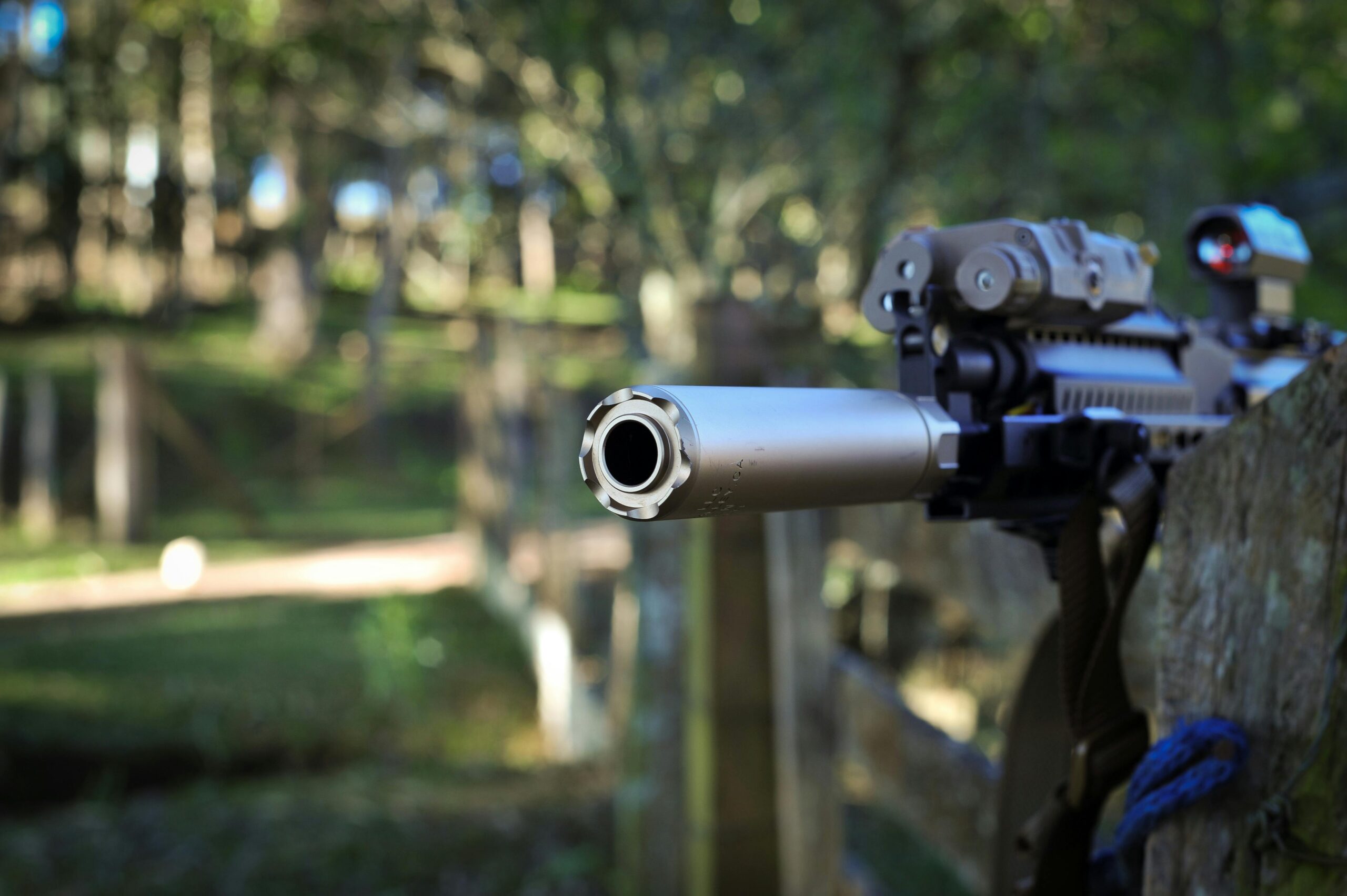
If you’ve ever searched “suppressor vs silencer” and wondered whether they’re two different products, you’re not alone. It’s one of the most common questions in the firearms community. The confusion is real, it’s widespread, and it has a history behind it.
What the Terms Actually Mean
The word “silencer” goes back to 1909. Inventor Hiram Percy Maxim had been developing and selling the Maxim Silencer since around 1902. The patent was officially granted on March 30, 1909.
At the time, truth-in-advertising standards were practically nonexistent. Claiming a device could “silence” a firearm was simply good marketing. The name stuck in legal language, in casual conversation, and eventually in federal law.
As the science of sound reduction developed, true silence proved unachievable. The more accurate term, “suppressor,” started appearing in technical contexts. Its earliest documented use is in US Patent No. 4530417, granted July 23, 1985. From there, it became the preferred term among manufacturers, military, and serious shooters.
You may also hear these informal terms in the field:
- Can – refers to the cylindrical shape of most suppressors
- Muffler – draws a direct comparison to what these devices do for a car engine
Suppressor vs Silencer: Are They the Same Thing?
Yes. The suppressor vs silencer question has a straightforward answer: they are the exact same device. There is no technical difference, no performance difference, and no legal difference. One term is just older.
The ATF and the National Firearms Act still use “silencer” as the official statutory term. When you file paperwork to purchase one, the form says silencer. The industry has largely moved to “suppressor” because it is more accurate. Legally and functionally, the two are interchangeable.
Hollywood deserves a fair share of the blame here. Movies have conditioned audiences to believe suppressors eliminate all sound, turning a gunshot into a soft whisper. That is fiction. Real suppressors reduce sound. They do not eliminate it.
That misconception, combined with two competing terms in circulation, is why so many people assume they are different devices. They are not.
How a Suppressor Actually Works
A suppressor attaches to the muzzle and slows down the expanding gases produced when a round is fired. Inside is a series of baffles, chambers that redirect and trap those gases before they exit. This reduces the pressure spike behind the loud crack of a gunshot.
The result is real but measured. A quality suppressor typically reduces muzzle sound by 14 to 43 decibels, depending on caliber and design. That can bring a standard rifle shot from a damaging 160+ dB down to a safer range. It is not whisper-quiet. You will still hear the shot.
Subsonic ammunition plays a key role in maximizing suppression:
- Standard ammo travels faster than the speed of sound, creating a separate sonic crack
- Subsonic loads eliminate that crack entirely
- The right suppressor and subsonic ammo combination produces the most noticeable noise reduction
Flash Suppressor vs Sound Suppressor: Not the Same
A flash suppressor and a sound suppressor are two entirely different muzzle devices. Confusing them is one of the most common mistakes among newer shooters.
Flash suppressor (flash hider): Reduces visible muzzle flash when a round is fired. It helps the shooter maintain night vision and reduces visual signature. It does almost nothing for sound.
Sound suppressor: Reduces the acoustic signature of a gunshot. As a secondary effect, it can also reduce or eliminate muzzle flash. The baffles trap and cool gases that are still burning as they exit the muzzle. This is a side effect, not the primary function.
Muzzle brake: Redirects propellant gases to reduce felt recoil and muzzle rise. It can actually increase the sound signature for bystanders to the side. Each device solves a different problem.
NFA Regulation and the Legal Definition of a Silencer
Under the National Firearms Act of 1934, silencers were placed under federal regulation. They were grouped alongside machine guns, short-barreled rifles, short-barreled shotguns, destructive devices, and other regulated items. The $200 transfer tax became the defining requirement, and it stayed fixed for over 90 years.
Purchasing a suppressor historically required:
- Completing ATF Form 4
- Submitting fingerprints and photographs
- Passing a background check
- Paying the $200 tax
- Waiting 6 months to over a year for approval
That changed on July 4, 2025, when the One Big Beautiful Bill was signed into law. Starting January 1, 2026, the $200 federal excise tax on suppressors was eliminated.
What still applies: ATF Form 4, background check, and NFA registration remain in effect. Suppressors are still regulated items. You still need to complete the proper federal process.
There is also active litigation in federal court. Several Second Amendment organizations filed suit challenging whether NFA registration can legally stand without a tax. That case is ongoing as of early 2026.
The Suppressor vs Silencer Debate in Practical Use
In everyday use, the suppressor vs silencer distinction is mostly a regional and generational divide. Older shooters and hunters tend to say silencer. Younger shooters in the tactical and precision rifle space tend to say suppressor. Neither is wrong.
Manufacturers use both terms, sometimes on the same product page. Legal documents filed with the ATF say silencer. Product listings online may use suppressor, silencer, or can depending on the copy.
If you are searching for products, use both terms. Results for suppressor and silencer return the same items because the industry treats them as the same thing.
Benefits of Owning a Suppressor
Hearing protection is the primary reason most people buy a suppressor. Repeated exposure to unsuppressed gunfire causes cumulative hearing damage. Even a single unsuppressed shot can cause temporary threshold shifts.
Other real benefits include:
- Improved accuracy – reduced recoil and muzzle flinch help shooters stay on target between shots
- Less disturbance – reduced muzzle blast minimizes disruption to game and neighboring properties
- Multi-caliber flexibility – a well-engineered design like the Liberty Suppressors Mystic X works across multiple calibers, reducing cost and paperwork
What to Look for When Buying a Suppressor
Start with decibel reduction ratings and caliber compatibility. Not all suppressors are rated for all cartridges. Running a round that exceeds the suppressor’s pressure rating can cause damage.
Key specs to evaluate before buying:
- Weight and length – a long, heavy suppressor suits bench rest but may be impractical on a compact carbine
- Mount type – direct thread is simple and cost-effective; quick-attach lets you swap across multiple hosts faster
- Material – titanium is lightest and handles heat well; stainless steel is heavier but extremely durable; aluminum is cost-effective but not suited for high-volume fire
American-made construction means tighter tolerances, better quality control, and manufacturers who stand behind their work.
Conclusion
The suppressor vs silencer debate is not really a debate at all. Both terms describe the same device. The difference is historical, not technical. Silencer came first, suppressor came later, and both remain in active use across the industry.
What has changed is the legal landscape. The $200 federal tax was eliminated as of January 1, 2026. With ongoing litigation that could further ease ownership, now is a relevant time to explore suppressed shooting.
Liberty Suppressors is based in Trenton, Georgia. Every suppressor ships to your door with no shortcuts and a lifetime guarantee. Whether you want a multi-caliber option like the Mystic X or a purpose-built rifle can.
Frequently Asked Questions (FAQs)
1. Is there a legal difference between a suppressor and a silencer?
No. The ATF and NFA officially use “silencer,” but it refers to the same device the industry calls a suppressor. Fully interchangeable under federal law.
2. Do suppressors make a firearm completely silent?
No. Suppressors reduce sound, they do not eliminate it. Typical reduction ranges from 14 to 43 decibels. A suppressed gunshot is still clearly audible.
3. Do I still need a tax stamp after January 1, 2026?
The $200 federal excise tax was eliminated starting January 1, 2026. ATF Form 4, background check, and NFA registration still apply.
4. Can one suppressor work on multiple calibers?
Yes, with the right design. Multi-caliber suppressors like the Liberty Suppressors Mystic X cover a wide range of calibers under a single tax stamp.
5. Is the terminology regional?
Partly. Hunters and older shooters tend to say silencer. The tactical and precision communities lean toward suppressor. Both are correct and return the same search results.