

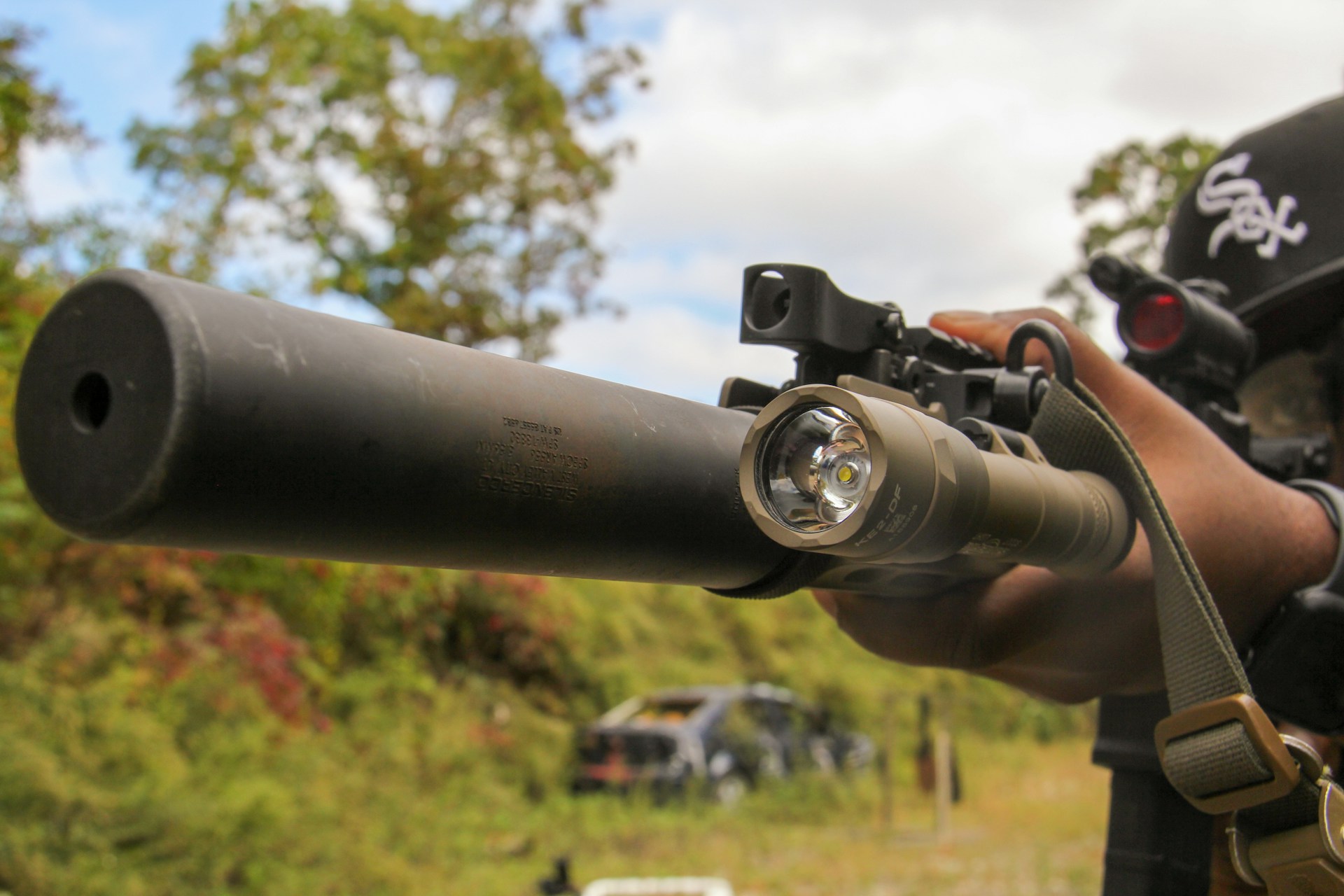
You know that feeling when you’re excited about getting something new, but the paperwork and waiting take all the fun out of it? That’s exactly what it can feel like when you’re dealing with suppressor taxes and the NFA process. You want that suppressor to cut down noise and make shooting more enjoyable, but first, you have to get through the federal requirements.
The law requires all NFA firearms, including suppressors, to be registered with a paid tax as part of the process. If you want a silencer to reduce the sound of your firearm, you’ll need to pay the fee and file the paperwork to make it official.
In this blog, we’ll break down everything you need to know about suppressor taxes so you can decide what makes the most sense for you. But before that, let’s break some happy news for you!
Breaking News: $0 Tax Stamps Coming in 2026
This is huge news for anyone interested in suppressors. In 2025, H.R.1 (One Big Beautiful Bill) passed with $0 tax stamps for suppressors, SBRs, SBSs, and AOWs starting January 1, 2026. This means that starting next year, you won’t have to pay the $200 NFA tax that’s been around since 1934.
But here’s what you need to consider: you’ll be competing with every suppressor buyer in America. It will save you some money, but you may run into longer approval times and supply issues. Obviously, when something that costs $200 suddenly becomes free, everyone’s going to want it.
What Exactly Is a Suppressor Tax Right Now?
As of late 2025, a suppressor tax is still a federal requirement enforced by the Bureau of Alcohol, Tobacco, Firearms and Explosives (ATF). The law is crystal clear. If you want to purchase a suppressor for your firearm before January 2026, you must pay this $200 tax to comply with federal law.
This tax requirement comes from the National Firearms Act (NFA) of 1934, which regulates certain types of firearms and accessories. The whole point was to collect taxes on specific firearms and accessories like silencers, machine guns, short-barrel rifles, and short-barrel shotguns.
The tax is essentially proof that you’ve paid the necessary $200 fee to the federal government for each suppressor you want to own. That fee has stayed exactly the same since the NFA was enacted in 1934. While $200 was serious money back then (equivalent to several thousand dollars today), it’s much more manageable now.
Current Processing Times For Suppressor Tax
If you decide to purchase now instead of waiting for 2026, the good news is that wait times are at record lows. As of August 2025, the average approval time is just 3 days for trust filings and 2 days for individual filings.
Many gun owners in 2025 are seeing approvals come through faster than their next ammo order arrives. Electronic submissions are being processed anywhere from 1 to 59 days, with a large number completed much sooner. In some cases, eForm approvals are finalized in under a week.
This is a huge improvement compared to the past, when applicants often waited six to twelve months. The process today is faster, smoother, and more convenient than it has ever been.
Should You Buy Now or Wait Until 2026?
This is the million-dollar question (or should I say, the $200 question). Here are the factors to consider:
Reasons to Buy Now:
-
- Lightning-fast approvals: Individual Electronic Form 4 averages 4.8 days, while Electronic Form 4 for a trust or corporation averages 4.6 days.
-
- Immediate availability: You can have your suppressor in hand within weeks
-
- Avoid the rush: No competition with every other suppressor buyer in America
-
- Guaranteed supply: Current inventory levels are stable
Reasons to Wait Until 2026:
-
- Save $200 per suppressor: That’s real money, especially if you want multiple suppressors
-
- No tax burden: Hold off until the bill passes, wait through the implementation period (January 2026), and then file without a $200 tax stamp
The Downside of Waiting:
-
- Massive demand surge: Everyone will want to buy suppressors when they become “free.”
-
- Longer wait times: Processing times will likely increase dramatically
-
- Supply shortages: Manufacturers may struggle to keep up with demand
-
- Higher suppressor prices: Dealers might raise prices when demand explodes
The Real Cost Breakdown for 2025
If you buy before January 2026, here’s what you’re looking at cost-wise:
The suppressor tax itself is still a flat $200 per suppressor. That’s it. No sliding scale based on the suppressor’s value, no different rates for different types. Whether you’re buying a basic .30 can or a high-end titanium suppressor, the tax is always $200.
But remember: this $200 is completely separate from the cost of the suppressor itself. So if you’re looking at a $600 suppressor, your total cost will be $800 plus any dealer fees or shipping costs.
Also, this is per suppressor. Want three suppressors? That’s $600 in taxes alone. Each suppressor needs its own individual tax payment and approval process.
How the Suppressor Tax Process Works Right Now
Step 1: Pick Your Suppressor
First things first. Head to a licensed firearms dealer who specializes in suppressors. This isn’t the time to guess or shop around casually. You need to make sure you’re getting the right suppressor for your specific needs.
Consider these factors:
-
- Make sure the suppressor matches your firearm’s caliber
-
- Think about how you’ll use it (hunting, target shooting, home defense)
-
- Consider the materials (stainless steel, titanium, aluminum) and their trade-offs
-
- Decide if you want versatility for multiple guns or specialization for one specific use
Step 2: Complete ATF Form 4
This is where things get official. You’ll need to fill out Form 4, which is called the “Application for Tax Paid Transfer and Registration of Firearms.” This form is mandatory for legally transferring the suppressor to you.
Here’s what you’ll need:
-
- Your complete personal information (full name, address, date of birth, place of birth)
-
- Social Security Number (technically optional, but it speeds up background checks)
-
- Complete suppressor details (make, model, serial number, caliber, manufacturer)
-
- A recent passport-style photograph
-
- Two sets of fingerprints on ATF-compliant FD-258 cards
-
- Trust or legal entity documents if you’re buying through a trust
Step 3: Get Fingerprinted and Photographed
You’ll need to visit either a local law enforcement agency or an authorized fingerprinting service. Make sure they use the proper ATF-compliant FD-258 fingerprint cards. Not just any fingerprint cards will work.
For the photo, you need a clear passport-style shot with your head and shoulders against a plain background. Think passport photo, not selfie.
Step 4: Notify Your Chief Law Enforcement Officer (CLEO)
Good news. This used to be much more complicated. You used to need approval from your local CLEO, but now you just need to notify them. Send a copy of your completed Form 4 to your county sheriff or local police chief. They don’t need to do anything with it; this is purely for notification purposes.
Step 5: Pay That $200 Tax (For Now)
Here’s where you actually pay the suppressor tax. Write a check or money order payable to the “Bureau of Alcohol, Tobacco, Firearms, and Explosives.” Make sure to include the suppressor’s serial number on your payment. This helps the ATF process everything correctly.
Some dealers might accept credit card payments for the tax, so ask about your options. Just remember, this $200 is separate from whatever you’re paying for the actual suppressor.
Step 6: Submit Everything Electronically
The eForm process is much faster than mailing paper forms. Paper Form 4 filings for trusts or corporations are still averaging about 212 days. By comparison, electronic forms are often approved within just a few days.
Your complete application packet should include:
-
- Completed and signed Form 4
-
- Two fingerprint cards
-
- Passport-style photo
-
- $200 tax payment
-
- Any trust documents, if applicable
Step 7: Wait for Approval (It Won’t Be Long)
This used to be the hardest part, but not anymore. Submit Perfect Paperwork: The ATF will reject a Form 4 with any error, and if that happens, you’ll have to start over. But if you submit everything correctly through the eForm system, you’re looking at approval times of just days or weeks.
Once approved, the ATF will send your tax stamp to your dealer electronically, and you can pick up your suppressor almost immediately.
What Happens After 2026?
While the $200 tax is going away, full deregulation was blocked, but legal challenges may follow. This means you’ll still need to go through the ATF approval process, but you won’t have to pay the $200 fee.
You’ll still need:
-
- ATF Form 4 or Form 1
-
- Background check
-
- All the same paperwork and requirements
-
- ATF approval before taking possession
The only thing changing is the cost.
State Laws Still Matter
Before you get too excited about federal changes, make sure suppressors are actually legal in your state. Not all states allow civilian suppressor ownership, and some have additional restrictions beyond federal requirements.
The federal tax change won’t matter if your state prohibits ownership entirely.
The Bottom Line
You’re living through a historic time in suppressor ownership. The $200 tax that’s been around since 1934 is about to disappear, but that doesn’t necessarily mean you should wait.
Right now, approvals are faster than ever, inventory is available, and you could have a suppressor in hand within weeks.
Getting a tax stamp is required, but the process is simpler than most expect. File electronically, know your state laws, choose the right ownership structure, and keep your paperwork organized.
Want to make it easy? Liberty Suppressors can guide you through every step, review your application, and handle the filing so you can focus on shooting. Contact us today to get started.