

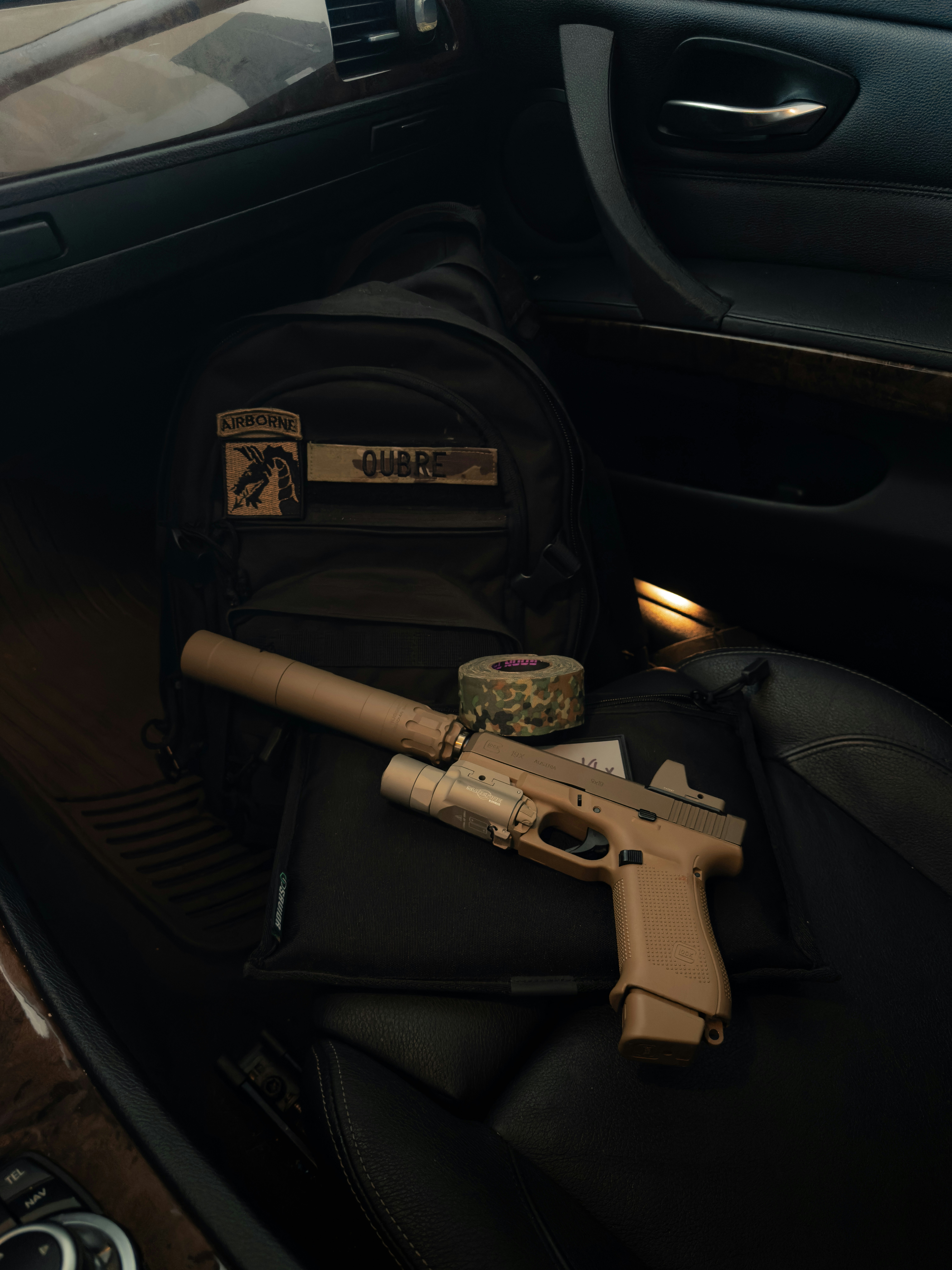
Finding the best 9mm pistol suppressor is one of the most common questions handgun owners wrestle with. Do you need a dedicated 9mm can? Will it cycle your pistol? Is the paperwork worth it?
Those questions are fair. This article breaks down how suppressors work and what makes one better suited for your setup than another.
What a 9mm Suppressor Actually Does
A suppressor works by giving expanding gas somewhere to go before it exits the muzzle. Instead of all that pressure venting at once, it moves through a series of baffles inside the tube. The result is a reduced sound pressure level at the shooter’s ear.
The 9mm cartridge suppresses very well, especially with the right ammunition. You can realistically bring sound levels below 140 dB, which is widely considered the threshold for hearing damage.
Beyond noise reduction, suppressors also:
- Reduce muzzle flash
- Take some bite off felt recoil
- Make rapid follow-up shots more comfortable
How Handgun Suppressors Differ from Rifle Suppressors
This is where a lot of first-time buyers get caught off guard. Most semi-automatic pistols use a tilting or moving barrel to cycle the action. Adding suppressor weight to that barrel can prevent it from cycling reliably, or at all.
The fix is a Nielsen device, also called a piston or booster. It’s a spring-loaded mechanism that attaches between the suppressor and the barrel. It increases rearward energy during firing to help the barrel unlock and cycle properly. Without it, your pistol may short-stroke or fail to feed.
Fixed-barrel guns like PCCs and compact subguns don’t have this problem. They use a fixed mount instead. Knowing your host firearm’s action type before buying is essential.
Key Factors When Selecting the Best 9mm Pistol Suppressor
Sound Reduction and dB Ratings
Most 9mm cans list their sound reduction in decibels. A quality suppressor brings a standard 9mm load down to the 130 to 140 dB range. Going subsonic drops that further.
Pay attention to “at the ear” (ATE) measurements, not just muzzle measurements. ATE is the number that actually matters for your hearing.
Build Materials: Titanium, Stainless Steel, Aluminum Trade-Offs
Each material has its role:
- Titanium — lightweight and strong, popular for outer tubes
- Stainless steel — heavier but handles heat and erosion better, common for baffles
- Aluminum — lightest option, but less durable under repeated fire and harsh solvents
Many quality suppressors combine materials, using each one where it makes the most sense.
Size and Weight for Pistol Balance
A heavy suppressor on a short pistol barrel throws off balance. For handgun use, compact and lightweight is almost always better. Extra length is manageable on a PCC or home defense setup. On a carry pistol, it matters a lot more.
Mounting System: Direct Thread vs. Quick-Detach
- Direct thread — simple, reliable, more affordable; thread the can directly onto your barrel
- Quick-detach (QD) — uses a mounting adapter, allows fast swaps between multiple host firearms
User-Serviceable vs. Sealed Designs
9mm runs dirty. Carbon buildup happens fast, especially with brass-cased or lead-core ammo. A take-apart suppressor lets you clean the baffles and extend the life of the can. Sealed designs are simpler to run but harder to maintain over time.
Multi-Caliber vs. Dedicated 9mm Builds
A dedicated 9mm suppressor is optimized for that cartridge. A multi-caliber can trades some of that optimization for flexibility across different firearms. Neither is the wrong choice. It depends on what else is in your safe.
Dedicated vs. Multi-Caliber Suppressors for 9mm Pistols
If your only host is a 9mm pistol, a dedicated can makes a lot of sense. The baffles are tuned for 9mm pressures and velocities. That often means better sound performance and a smaller footprint.
If you have a mix of handguns, rifles, or rimfire guns, a multi-caliber option covers your whole collection. No need to buy and register multiple suppressors.
First-time buyers often benefit more from a multi-caliber design. Your needs tend to expand over time.
Top Performing Best 9mm Pistol Suppressor Options
Compact and Dedicated: Liberty Centurion
The Liberty Centurion is purpose-built around 9mm performance. It is also rated for 300 BLK (on barrels 7.5 inches or longer) and 22LR.
Key specs:
- dB Overall: ~136.6 dB (including first-round pop)
- dB Reduction: 24 dB dry / 32 dB wet
- Added length: ~6 inches to the host firearm
- Construction: Titanium outer tube / stainless steel core
- Finish: C-Series Cerakote
It’s a take-apart design, which is critical for a pistol can. The stainless steel core handles harsh solvents and ultrasonic cleaning without issue.
The Centurion Kit includes a 1/2-28 booster and two low-profile direct thread adapters. That covers both handgun and PCC use right out of the box. Made in Georgia, USA, with a lifetime guarantee.
Multi-Caliber Versatility: Liberty Mystic X
The Mystic X covers over 70 calibers, from 9mm up to 300 Win Mag on appropriate platforms. Built with a titanium outer tube and a 17-4 PH stainless steel core.
It uses Liberty’s MX family of mounts, with options for fixed barrel, booster, and Triad-style attachment. If you own more than one firearm, the Mystic X covers all of them. It’s take-apart, easy to clean, and carries a lifetime guarantee from Liberty Suppressors.
Modular 9mm Designs Worth Knowing
Modular suppressors switch between a full-length configuration for maximum suppression and a shorter K-length for compact handling. The trade-off is added complexity in mounting hardware and a higher price. If adaptability matters to your use case, modular designs are worth factoring in.
Suppressor-Ready Pistol Requirements
Before running a suppressor on your handgun, the barrel must be threaded. The most common pitch for 9mm is 1/2×28. Most major manufacturers offer factory-threaded models, and aftermarket options exist for nearly every popular platform.
Suppressor-height sights matter too. A standard suppressor sits directly in your sightline with factory-height sights. Taller sights let you co-witness over the top of the can. Some factory suppressor-ready models include these out of the box.
Always confirm your barrel length meets the suppressor manufacturer’s minimum requirement before purchasing.
Subsonic Ammunition and the Best 9mm Pistol Suppressor Setup
Running the best 9mm pistol suppressor without subsonic ammo leaves performance on the table. Here’s why.
Any bullet traveling faster than roughly 1,125 fps creates a sonic crack as it breaks the sound barrier. That crack adds noise after the suppressor has already done its job.
Subsonic 9mm loads, typically 147 grain or heavier, stay below that threshold. The suppressor handles the muzzle blast, and subsonic ammo eliminates the sonic crack. The result is a significantly quieter report.
For suppressed handgun use, 147 grain factory subsonic loads are the most common and widely available starting point.
NFA Purchase Process Simplified
Suppressors are regulated under the National Firearms Act (NFA). Here’s what the process looks like:
- Complete ATF Form 4 — required for any NFA transfer
- Pass a background check — standard requirement
- Wait for ATF approval — then take possession from your dealer
As of January 1, 2026, the $200 federal tax stamp on suppressors was eliminated under Public Law 119-21. There is no longer a transfer tax for suppressor purchases. Form 4 filing and background check requirements remain in place.
eForm 4 submissions processed in days or weeks through much of 2025. With the surge in applications following the tax elimination, timelines in early 2026 may be longer. Check the ATF’s current processing times page before planning your purchase.
At Liberty Suppressors, you can order directly or through a local Class III dealer. Liberty provides a prefilled Form 4 packet through your dealer. Once approved, your dealer notifies you and you take possession.
An NFA gun trust is worth considering if multiple household members need legal access to the suppressor.
Suppressor Maintenance for 9mm Pistol Cans
9mm is one of the dirtier handgun calibers. Carbon builds up fast in the baffles, especially with brass-cased or lead ammo. That’s why take-apart designs matter so much for pistol use.
Cleaning methods for take-apart suppressors:
- Ultrasonic cleaning tanks
- Solvent dipping (safe for stainless steel cores)
- Physical scrubbing for light fouling
For Liberty suppressors, stainless steel cores handle harsh solvents well. Protect Cerakoted outer surfaces during aggressive cleaning.
Inspect and clean after every 500 rounds on pistol-caliber cans, or sooner if you notice sound degradation. Lead and dirty loads need more frequent attention. Neglecting maintenance is the fastest way to shorten a suppressor’s lifespan.
Conclusion
The gap between an average can and the best 9mm pistol suppressor comes down to four things. Build quality, sound performance, serviceable design, and mounting compatibility.
The Liberty Centurion delivers purpose-built 9mm performance in a compact, lightweight package. The Liberty Mystic X covers over 70 calibers and works across an entire collection. Both are American-made, lifetime guaranteed, and built from bar stock, not stamped pieces.
The best 9mm pistol suppressor is one built to last and matched to how you shoot.
Frequently Asked Questions (FAQs)
1. Do I need a special barrel to use a 9mm pistol suppressor?
Yes. Your barrel needs to be threaded, typically 1/2×28 for 9mm. Most major manufacturers offer factory-threaded models, and aftermarket barrels are widely available.
2. Will a suppressor damage my pistol over time?
Not when used correctly. A suppressor with the right booster for your pistol’s action type won’t cause extra wear. Running without a booster on a tilting-barrel pistol can cause cycling issues.
3. How long does it take to get a suppressor approved?
The $200 tax stamp was eliminated in January 2026, driving a surge in applications. eForm 4 approvals ran days to weeks through 2025. Post-surge timelines are variable. Check the ATF’s current processing times page for current data.
4. Can I use one suppressor on multiple 9mm handguns?
Yes, as long as the thread pitch matches, typically 1/2×28, or you have the right adapters. Liberty’s MX mount system makes swapping between hosts straightforward.
5. Is a dedicated 9mm suppressor better than a multi-caliber option?
For pure 9mm performance, a dedicated can often wins on sound and weight. For owners with multiple calibers, a multi-caliber suppressor like the Liberty Mystic X is the more practical choice.