

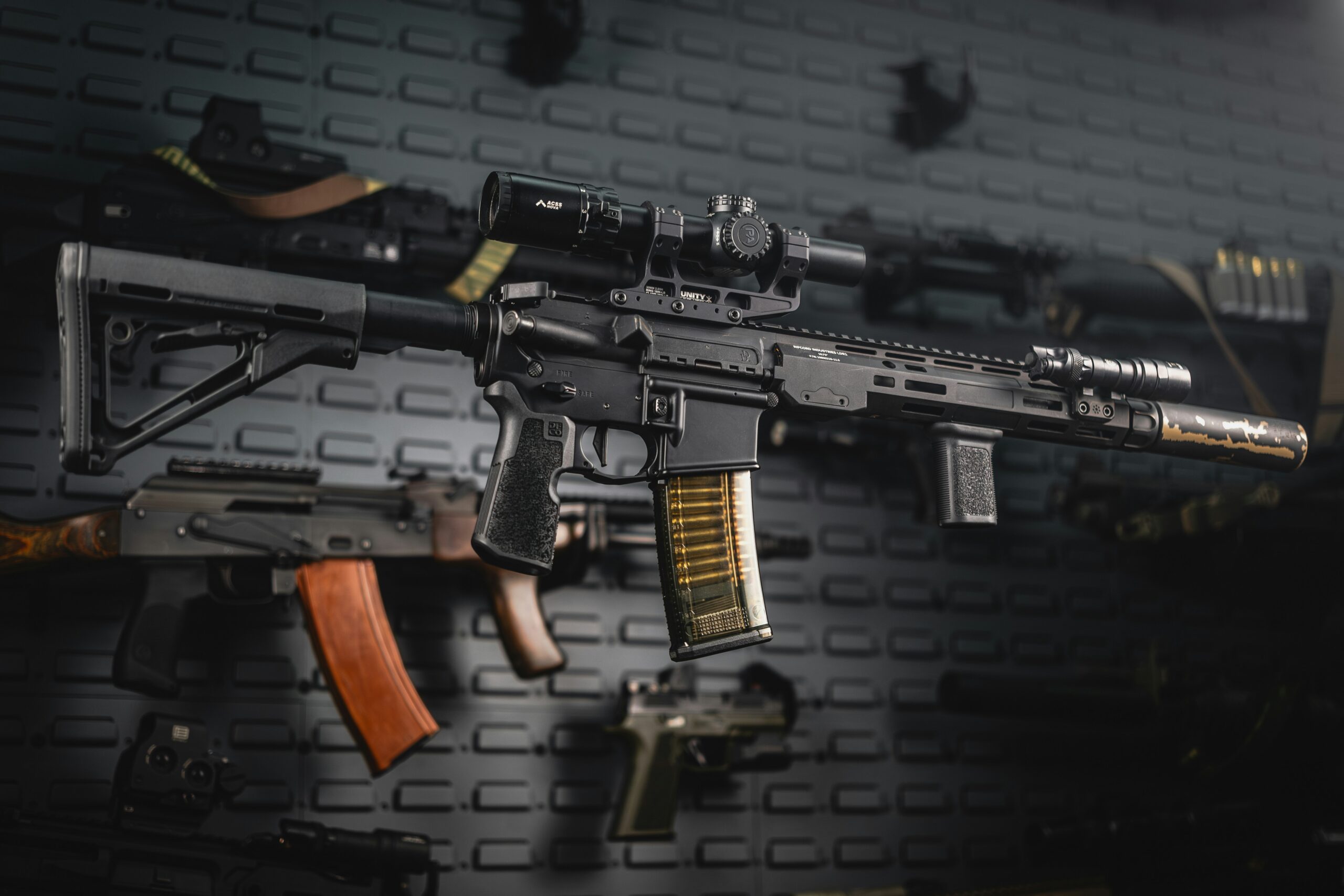
If you’re looking to add an M&P 15-22 suppressor to your build, you’re already thinking in the right direction. The Smith and Wesson M&P 15-22 is one of the most suppressor-friendly rimfire rifles on the market. This guide covers everything you need to know, from barrel threading to NFA paperwork to ammo selection.
Why the M&P 15-22 Is a Natural Platform for Suppression
The M&P 15-22 hits the sweet spot for suppressed shooting. It’s chambered in .22LR, built on an AR-style form factor, and comes standard with a 16.5-inch threaded barrel from the factory. The polymer upper and lower keep overall weight low. That means you can add a suppressor without throwing off the balance of the whole build.
It’s a popular choice for new shooters, youth training, and high-volume plinking. Low recoil, affordable ammo, and broad AR accessory compatibility make it one of the most versatile rimfire rifles available. Add a suppressor, and the platform gets even better. The factory threading means zero gunsmithing work before mounting a can.
M&P 15-22 Barrel Threading and Suppressor Fit
Standard Thread Specification
The M&P 15-22 barrel is threaded at 1/2×28 TPI. This is the same thread standard used on most .22LR rifles and standard AR-15 builds. That’s a real advantage. It gives you access to a wide range of rimfire suppressors without specialty mounts or adapters.
If you already own a 1/2×28 suppressor, there’s a good chance it will mount directly without modification. Always confirm thread pitch and verify compatibility with your suppressor manufacturer before mounting.
Thread Length and Spacing Considerations
One detail that catches some M&P 15-22 owners off guard is thread length. On certain variants, the threaded section is shorter than on a standard 5.56 AR barrel. This creates a gap between the suppressor’s shoulder and the barrel shoulder, preventing a flush, stable mount.
The fix is simple. A properly sized thread spacer fills that gap and ensures solid shoulder contact. Skipping it can cause alignment issues. In the worst case, a suppressor that isn’t sitting true with the bore can cause a baffle strike. Always confirm proper alignment before firing a suppressed round.
Thread-On vs. Integrally Suppressed Upper Options
Most M&P 15-22 owners run a thread-on suppressor. It mounts directly to the factory barrel, is portable, and transfers to any other 1/2×28 host. One NFA stamp, one suppressor, multiple firearms.
The alternative is an integrally suppressed upper. The suppressor is permanently fixed to a replacement barrel. The barrel vents gas into the can before the bullet exits. This drops velocity to subsonic levels regardless of ammo type, and the result is typically quieter than a thread-on setup.
The trade-off is a dedicated, non-transferable setup that costs significantly more. For most shooters, a quality thread-on rimfire suppressor is the more practical and cost-effective path.
What to Look for in an M&P 15-22 Suppressor
Weight, Length, and Material
Suppressor material matters more on a lightweight rimfire host than on a heavier centerfire rifle. Adding a heavy can at the muzzle shifts the balance point forward and affects how the rifle handles.
Here’s a quick breakdown:
- Aluminum — lighter but softer, more prone to wear over time
- Titanium — costs more, shaves significant weight, holds up better for high-volume use
Length is also a factor. A longer suppressor adds internal volume and generally delivers better sound reduction. On a rifle-length host like the M&P 15-22, the added length is manageable. On shorter pistol-length hosts, it becomes a bigger consideration.
Direct Thread vs. Quick-Detach Mounts
Direct thread suppressors screw onto the 1/2×28 barrel threads. They’re simple, durable, and well-suited for a dedicated setup where the can stays on the gun. Fewer parts to wear out, and alignment stays consistent over time.
Quick-detach (QD) mounts use a fixed adapter on the barrel. The suppressor locks onto that adapter and removes quickly without tools. If you’re running one suppressor across multiple hosts, QD makes transitions much faster.
For a dedicated M&P 15-22 build, direct thread is usually the better call. For a suppressor moving between several firearms, QD gives you the flexibility you need.
Cleanability and Rimfire-Specific Maintenance
This is one of the most overlooked factors in choosing a rimfire suppressor. .22LR is notoriously dirty. Lead fouling and carbon build up fast, especially with high round counts.
A suppressor you cannot disassemble will eventually clog. At that point you’re looking at professional cleaning or replacement. For high-volume rimfire shooters, a user-serviceable design is not optional. Plan to clean your rimfire suppressor every 500 to 1,000 rounds. Sealed suppressors are not a good match for this caliber.
Ammunition Selection for Suppressed .22LR Shooting
Supersonic vs. Subsonic .22LR
A suppressor reduces muzzle blast, but it cannot silence the sonic crack of a supersonic bullet. Once a bullet breaks the sound barrier, that crack travels downrange no matter what’s on the muzzle.
For real sound reduction, the bullet needs to stay subsonic. Most .22LR loads marketed as subsonic travel at or below 1,100 fps. That’s comfortably under the speed of sound at approximately 1,125 fps at sea level. No sonic crack, and the suppressor handles the rest of the report.
How the M&P 15-22’s Barrel Length Affects Velocity
The 16.5-inch barrel sits right at the sweet spot for .22LR powder burn, where the cartridge reaches near-peak velocity. Standard velocity loads are engineered to leave a rifle-length barrel at or near subsonic speeds. That’s not the barrel slowing the round down. The powder charge is simply designed to produce near-subsonic velocity from that barrel length.
High velocity loads will still exit the 16.5-inch barrel at supersonic speeds. They produce a sonic crack that no suppressor can eliminate. Stick with standard velocity loads and the M&P 15-22 does the rest of the work for you.
Optimal Ammo for a Suppressed Build
Two reliable choices for a suppressed M&P 15-22:
- CCI Standard Velocity — stays subsonic through a rifle-length barrel, cycles reliably
- Remington Target — similar performance, widely available, budget-friendly
If you’re running an integrally suppressed upper, avoid low-powered subsonic loads. Ported integral barrels are designed for standard or high velocity ammo. The ported barrel drops velocity naturally. Underpowered loads often fail to cycle the action in these setups.
NFA Requirements for the M&P 15-22 Suppressor
Suppressors are NFA-regulated items under federal law. Possession without completing the proper transfer process is illegal. Here’s what the process looks like:
- Purchase through a licensed Class III dealer
- Submit ATF Form 4 — electronically via eForm 4 for faster processing
- Pay the $200 tax stamp fee and pass a background check
- Wait for ATF approval — the dealer holds the suppressor until it clears
- Take possession once the approved Form 4 is returned
You can file as an individual or through an NFA Gun Trust. A trust allows co-trustees to legally possess and use the suppressor. It’s a practical option for households with multiple responsible adults. Individual filing is simpler if you’re the only user.
eForm 4 submissions generally process faster than paper filings. If your dealer supports it, file electronically.
Liberty Suppressors’ Rimfire Options for the M&P 15-22
The Regulator and Regulator Ti
Liberty Suppressors offers two dedicated rimfire cans that pair naturally with the M&P 15-22. The Regulator is an aluminum direct thread suppressor built for .22LR. It’s fully user-serviceable, making it a solid long-term choice for high-volume shooters.
The Regulator Ti is the titanium version. It’s noticeably lighter, which helps maintain the rifle’s natural handling feel and reduces muzzle-forward balance shift. Both are ship-to-door eligible through Liberty’s simplified purchasing program, and both are built at Liberty’s facility in Trenton, Georgia.
The Vector 22LR Silencer
The Vector is Liberty’s modular rimfire suppressor. It features an adjustable configuration so you can set the overall length to suit the application. For a rifle-length host like the M&P 15-22, run it at the configuration that maximizes sound reduction without adding unnecessary length.
It’s compact, lightweight, and built specifically for the demands of .22LR shooting at volume.
Multi-Host Versatility With Liberty’s Adapter System
One of Liberty’s practical strengths is the adapter system. A single suppressor mounts to virtually any compatible host using the right adapter. If you own multiple rimfire rifles with 1/2×28 threads, one Liberty suppressor with the right adapters covers the whole collection under a single NFA stamp. Liberty’s adapter catalog covers a wide range of thread configurations. All hardware is manufactured in the USA.
Conclusion
The M&P 15-22 is one of the most capable and suppressor-ready rimfire platforms available. The factory 1/2×28 threaded barrel, lightweight polymer build, and 16.5-inch barrel length work together to make suppressed shooting genuinely accessible.
Get three things right and the rest falls into place: thread compatibility, ammo selection, and NFA compliance. Once those are squared away, the results speak for themselves.
Explore Liberty Suppressors’ rimfire lineup, including the Regulator, Regulator Ti, and Vector 22LR Silencer. Take advantage of the ship-to-door program to simplify your purchase, get your paperwork moving, and take the next step toward building a proper M&P 15-22 suppressor setup.
Frequently Asked Questions (FAQs)
1. Does the M&P 15-22 come with a threaded barrel from the factory?
Yes. Most M&P 15-22 models ship with a factory threaded barrel at 1/2×28 TPI. Some variants include a thread protector over the threads.
2. Do I need a gunsmith to mount a suppressor on the M&P 15-22?
In most cases, no. If the barrel is threaded at 1/2×28 and the suppressor matches, it’s a direct installation. A thread spacer may be needed on certain variants to ensure proper shoulder contact.
3. Can I use a multi-caliber suppressor on the M&P 15-22?
Yes, if it’s rated down to .22LR and mounts at 1/2×28. Always confirm rimfire compatibility before mounting. Using a suppressor not rated for rimfire can damage the internals.
4. Is the M&P 15-22 loud without a suppressor?
Unsuppressed .22LR registers around 140 dB at the shooter’s ear, above safe exposure thresholds. A quality suppressor with subsonic ammo typically brings that down to approximately 110 to 116 dB.
5. How long does it take to get a suppressor approved in the US?
It varies. eForm 4 submissions have processed in as little as a few months. Paper filings take longer. Wait times shift based on ATF workload. Your dealer holds the suppressor until approval clears.